
Micronotes.ai Logo
  • What We Do
  • How We Do It
  • Products
  • Who We Are
  • Blog
  • Request A Demo
  • Log In
Micronotes.ai Logo
  • What We Do
  • How We Do It
  • Products
  • Who We Are
  • Blog
  • Request A Demo
  • Log In
  • What We Do
  • How We Do It
  • Products
  • Who We Are
  • Blog
  • Request A Demo
  • Log In
Micronotes.ai Logo
  • What We Do
  • How We Do It
  • Products
  • Who We Are
  • Blog
  • Request A Demo
  • Log In
Personalization
Home Archive by Category "Personalization"

Category: Personalization

User persona marketing concept.
Loan GrowthPersonalizationPrescreen MarketingStrategy

From Persona to Pipeline: Closing the Gap with Credit-Informed Targeting

Personas alone can’t drive loan growth—they need an execution layer. Learn how credit-informed prescreen marketing transforms static customer profiles into measurable lending outcomes.


Read More
June 19, 2026 0 Comments
The careful attention a man gives to paperwork in the car showroom crafts clarity in every contract, ensuring that each customer leaves with confidence and a new set of keys
Auto LendingBehavioral EconomicsPersonalizationPrescreen Marketing

The $440/Month Problem Hiding in Your Market

For every member who walks in seeking auto refinance help, dozens more are silently overpaying captive lenders. Proactive prescreen campaigns can capture these opportunities before inertia wins.

Read More
May 29, 2026 0 Comments
Computer keyboard do it #2
Big DataPersonalizationPrescreen Marketing

Why Prescreen Is the Fastest Path from Segmentation to 1:1 Personalization

Most banks remain stuck at broad segmentation despite having consumer permission to personalize. Prescreen marketing offers community FIs a compliant, ready-now activation layer that connects credit insight to action without a multi-year infrastructure overhaul.

Read More
May 15, 2026 0 Comments
Money down the Drain
PersonalizationStrategy

Why the Smartest Loan Growth Strategy Skips the Ad Auction Entirely

Digital ad campaigns waste 20-40% of budgets on bot traffic and execution failures. Prescreen marketing offers community FIs a direct path to qualified borrowers without the strategy-execution gap.

Read More
May 15, 2026 0 Comments
Frustrated man gesturing what do you want from me, so what, I don't know
PersonalizationPrescreen Marketing

The Personalization Gap Is a Loan Growth Gap

New research shows 89% of bank clients say offerings lack personalization. Community FIs that master data-driven prescreen marketing can capture borrowers fleeing impersonal experiences.

Read More
April 10, 2026 0 Comments
Young couple with their daughter happily moving into their new apartment after buying it with a bank loan. First-time homeowners enjoying freedom after years of renting, smiling in their new home.
AIPersonalizationPrescreen Marketing

From Credit Offers to Life Outcomes: Rethinking Prescreen Strategy

Prescreen marketing typically focuses on rates and credit limits. A shift toward outcome-based messaging—tying firm offers to member aspirations like homeownership or debt freedom—can unlock deeper engagement and differentiation.

Read More
March 31, 2026 0 Comments
London, United Kingdom
PersonalizationPrescreen MarketingStrategy

The Personalization Gap: Why Segmentation Isn’t Strategy

Most banks have data and consumer permission to personalize, but remain stuck at broad segments. Learn why prescreen marketing offers community FIs a practical path to true 1:1 personalization.

Read More
March 27, 2026 0 Comments
Closeup Midsection Of Smiling Senior Woman
Community Financial InstitutionsPersonalizationPrescreen Marketing

Scaling the Personal Touch: Data-Driven Lending That Feels Human

Community FIs win loyalty in vulnerable moments, but those interactions rarely scale. Learn how precision prescreen marketing can replicate branch-level empathy across your entire membership.

Read More
March 25, 2026 0 Comments
2026 new year goal plan action. Goal achievement. Ambition aiming success. Setup objective target business planning of new year concept. business planning in 2026. Target concept for new year 2026
Community BankingDepositsPersonalization

2026 Deposit Retention Playbook for Community FIs: Catch Signals, Not Just Rates

By Devon Kinkead

Why this matters now

From 2005–2025, deposit dynamics whipsawed: teaser-rate promotions pre-crisis, flight-to-quality in 2008–2009, a long low-rate lull, then 2022–2024’s rate shock and hot-money outflows. The consistent winner each cycle? Institutions that met customers at the moment of decision—not months later with a rate sheet. That’s the Micronotes thesis: detect, ask intent briefly, direct one clear path, and follow up automatically. Micronotes

History backs this. Heavy reliance on rate-sensitive or wholesale funds raises fragility; durable, relationship-driven core deposits stabilize earnings and liquidity. Empirical work finds that non-deposit/wholesale funding dependence elevates risk; banks that “rent” funding this way are more fragile through stress. Community banks, meanwhile, run with higher liquidity and greater dependence on core deposits, making a relationship-first retention model an advantage to press in 2026. 

The 2026 retention strategy

1) Wire up signal detection for money-in-motion

Instrument digital banking and core data to flag:
• Statistically exceptional deposits (windfalls, bonuses, asset sales)
• New/changed ACH payroll descriptors
• Brokerage outflows/rate-seeking patterns
• CD maturities and partial withdrawals

These are the “micro-moments” when balances are at highest risk of leaving—or most open to guidance. Micronotes’ deposit posts call out catching those signals as the foundation of retention. Micronotes

Why it works: Since the crisis, depositors’ preferences across deposit types changed—savings (flexible, liquid) surged while time deposits waned; the two have become more distinct economic choices. So you must identify which choice the customer is weighing right now and respond in kind. 

2) Start a 20–30 second microinterview—not a pitch

Ask three human questions inside mobile/online banking:

  1. “How long will you keep these funds?”
  2. “What matters more—yield or access?”
  3. “Any upcoming purchase or payoff?”

Then present one recommended action (not a buffet): HYS for liquidity, a purpose-tuned CD/ladder for time-bound goals, or book-a-banker for complex sums. This is the core Micronotes flow. Micronotes

Why it works: Advice at the moment of intent changes outcomes—e.g., a windfall stays local instead of drifting to a brokerage sweep—without a rate war. Micronotes

3) Redesign products as answers, not inventory

  • High-yield savings = “Park cash with access.”
  • CDs and short ladders (6–18 months) = “Match your timeline.” Add features like partial withdrawal or add-on options keyed to pay cycles or milestones.
  • Impact CDs for mission-driven brands can deepen loyalty and stickiness.

Micronotes emphasizes framing deposits around life events and timelines, then making maturity choices easy in-app (roll, resize, step-out) to curb silent attrition. Micronotes

Why it works: Since 2008, the complementarity between savings and time deposits has weakened; customers treat them as distinct tools, so positioning must be crisp and purpose-led. 

4) Close the execution gap with an internal “Deposit Desk”

Route high-value cases to a small, trained team within hours; pass the micro-interview summary so the first call is consultative, not exploratory. Track “time-to-human” as a KPI. Micronotes’ guidance leans hard on compressing detection-to-help, not consideration-to-rate. Micronotes

5) Measure quality, not just volume

Scorecard like a CFO:

  • 30/90-day save rate for exceptional deposits
  • CD rollover rate at first maturity (with proactive choices)
  • Primacy progression: add payroll + bill pay + card on file
  • Incremental margin (NIM + fees) net of acquisition/servicing

These are the Micronotes “quality deposit” metrics that show durability and relationship depth, not just headline balance. Micronotes

What history says to avoid in 2026

  • Blanket rate escalations: They buy balances but compress margin and attract hot money. When cycles turn, those dollars flee. (Recall the 2022–2024 outflows to MMFs and Treasuries.) Micronotes argues to “stop chasing rates; start catching signals.” Micronotes
  • Brokered CDs without a retention plan: Good for short-term liquidity, dangerous without in-app maturity options and timely outreach.
  • Wholesale-funding habits: Risky in stress, especially for smaller institutions. Focus on core deposit depth and primacy. 

Real-world plays to ship in 90 days

Weeks 1–2: Instrument the signals (exceptional deposits, ACH changes, rate-seeking patterns) and deploy the 3-question micro-interview. Map each path to a single action (HYS, CD/ladder, or banker). Micronotes

Weeks 2–4: Publish one modernized offer + story (e.g., add-on CD or community-impact CD). Train front lines with the same plain-English script used in-app. Consistency reduces abandonment. Micronotes

Weeks 4–8: Launch, coach weekly on path-level conversion (parking-cash → HYS funded; ≈12-months → CD opened; “unsure” → banker booked). Micronotes

Weeks 8–12: Prove lift on exceptional-deposit retention, CD rollovers, primacy gains, and incremental margin vs. controls; shift budget from blanket rate spend to the signal-driven loop that’s compounding returns. Micronotes

Add two underused levers

  1. Community impact and trust signals (CSR)
    Customers reward banks whose values are visible. Research links stronger CSR with higher deposit growth and lower funding costs—a trust dividend that boosts liquidity creation. Use local impact CDs and transparent reporting to convert goodwill into durable deposits. 
  2. Segment by deposit purpose
    The crisis years showed deposit types behave differently. Treat “emergency buffer,” “purchase-in-12-months,” and “income-from-principal” as distinct segments with distinct default paths and follow-ups. Elasticity evidence supports managing deposit types as differentiated inputs—not interchangeable buckets. 

The 2026 bottom line

You won’t out-rate megabanks and fintechs. You can out-value them—by catching decisions as they form and making the next step obvious, fast, and human when it matters. Community institutions already lead in core deposits and local trust; the Micronotes model turns that into measurable retention and primacy at a lower cost than rate wars. Start by turning on the signals, asking three great questions, and giving one great answer—every time. Micronotes


Sources: Micronotes deposits playbooks on signal-driven engagement, micro-interviews, and quality-deposit metrics; empirical findings on deposit type behavior and funding risk; and community-bank core-deposit strengths.

Governance note: The 2008–2010 policy response underscored how system fragilities outside traditional deposits can force drastic measures. A forward-leaning, relationship-driven deposit strategy is not just marketing; it’s resilience.

Read More
December 5, 2025 0 Comments
First-Time HomebuyerHome Equity Loan ConsolidationPersonalizationPrescreen Marketing

When Purpose Meets Precision: How Wright-Patt Credit Union Is Turning 172,000+ Opportunities Into Homeownership Reality

By Devon Kinkead

When Savana Morie’s recent article in Credit Unions Magazine highlighted Wright-Patt Credit Union’s transformative Pathways to Homeownership initiative, it struck a particularly personal chord for me. Having spent the first 18 years of my life in Dayton, Ohio, I’ve witnessed firsthand the challenges facing Northwest Dayton—the very communities Wright-Patt is working to revitalize.

But beyond the personal connection, this story represents something even more powerful: the intersection of mission-driven purpose and data-driven precision that defines modern credit union growth.

The Challenge Hidden in Plain Sight

Wright-Patt Credit Union ($9.3B, Beavercreek, OH) has emerged as one of the two largest purchase-money lenders in the Dayton area, with more than half their mortgages going to first-time buyers. As President and CEO Tim Mislansky shared with Morie, “Affordable homeownership is one of the keys to financial success. When we can help members become homeowners, we can help them build wealth, strengthen families, and create lasting communities.”

That commitment is admirable—and it’s backed by a $1.3 million investment from the WPCU Sunshine Community Fund to construct 30 new homes in Northwest Dayton over the next three years. But here’s the question every mission-driven credit union must ask: How do you find the right people to fill those homes?

The Data Behind the Dream

This is where prescreen marketing transforms theory into impact. Our recent (Sep 2025) Growth Opportunities Analysis for Wright-Patt Credit Union revealed something remarkable:

Within just 5 miles of Wright-Patt’s 40 branches, there are 172,328 credit-qualified individuals ready for mortgage opportunities—representing a potential loan volume of $35.8 billion.

Let me put that in perspective. While Wright-Patt is building 30 homes over three years through their Pathways initiative, there are over 172,000 qualified mortgage candidates already living in their branch network footprint. These aren’t random names—these are real people who:

  • Have FICO scores between 680 and 850
  • Have demonstrated responsible credit behavior with no current delinquencies
  • Meet industry standard underwriting criteria (below)
  • Live within a short drive of a Wright-Patt branch
  • Are currently without a mortgage or are first-time homebuyers
Criteria DefinitionRule Summary
  FICO Score  Between 680 and 850.
Total number of debt counseling trades excluding collections  Equal to 0.
  Total number of trades presently 30 or more days delinquent or derogatory excluding collections  Equal to 0.
Total number of trades ever 30 or more days delinquent or derogatory occurred in the last 12 months including collections  Equal to 0.
  Total number of trades ever repossessed  Equal to 0.
Number of months since the most recent trade ever charged-off including indeterminates  No charged-off trades ever.
  Total number of public record bankruptcies  Equal to 0.
Total number of trades excluding collections and student loans including indeterminates  Greater than or equal to 3.
Number of months since the oldest trade was opened excluding collections and student loans including indeterminates  Greater than 36.
  Total number of non-medical collection trades  Equal to 0.
Total balance on medical collectionsLess than or equal to $2,000.
Total number of first mortgage trades ever foreclosed including settled first mortgages  Equal to 0.

Not all 172,328 will qualify for enough of a loan to meet market home prices so, the credit union should take market prices into account when designing the prescreen campaign ensuring that any such policy does not create a disparate impact under the ECOA or Fair Housing Act.

From Mass Marketing to Mission Alignment

Traditional mortgage marketing casts a wide net and hopes for the best. Prescreen marketing does something fundamentally different: it identifies individuals who already qualify for your specific lending criteria before you ever reach out.

For Wright-Patt’s Pathways to Homeownership initiative, this precision matters even more. Director of Community and Social Impact Ivy Glover told Morie that the program includes a five-week homeownership readiness program, one-on-one coaching, and financial education sessions. That’s a significant investment of time and resources—which makes targeting the right candidates from the start absolutely critical.

“We didn’t just cut a check,” Glover explained. “We committed to making homeowners.”

The Micronotes Advantage: Turning Data Into Opportunity

Our Automated Prescreen™ platform analyzed 1,809,213 Experian records within 5 miles of Wright-Patt’s branch locations. After applying Wright-Patt’s underwriting criteria, we identified 723,188 qualified prospects across all loan categories.

For mortgage opportunities specifically, here’s what we found:

  • 172,328 qualified mortgage candidates
  • $35.8 billion in potential loan volume
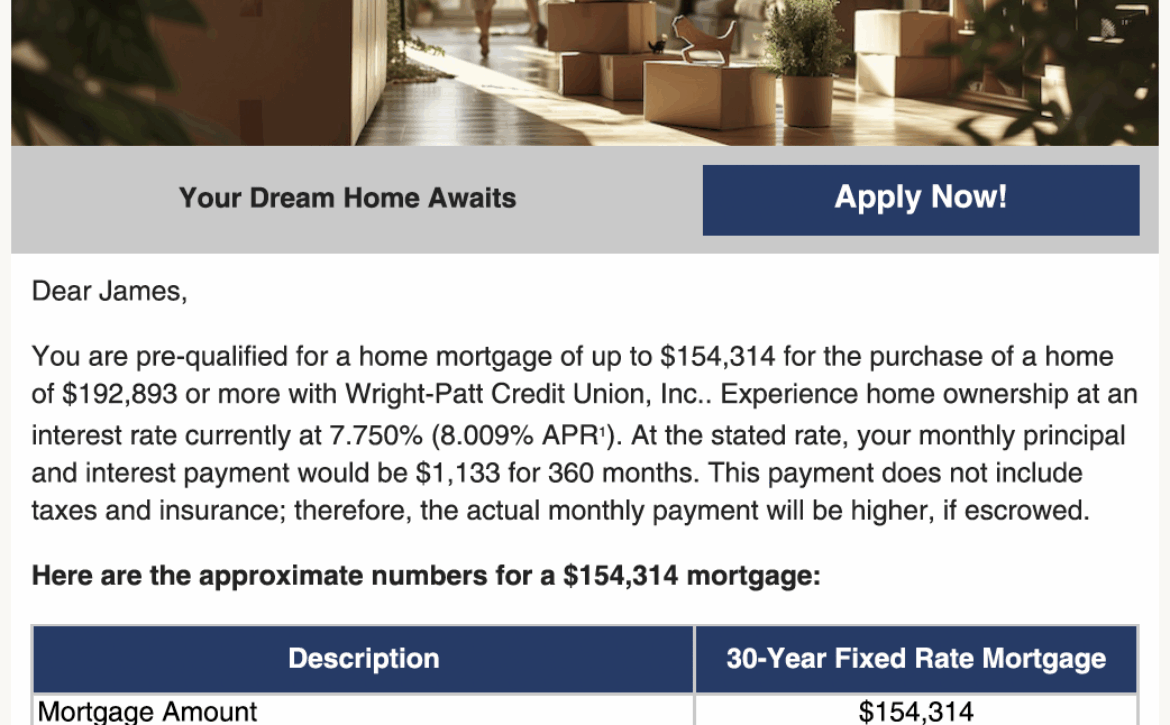
  • Average loan qualification: $154,314
  • All candidates living within a 5-mile radius of 40 branches across 182 zip codes

Once the program is executed, each prospect receives a personalized, firm offer of credit—not a generic “you might qualify” message, but an actual pre-qualified offer with specific loan amounts, rates, and monthly payments based on their individual financial profile.

Bridging the Education Gap

One of Glover’s key insights in the article particularly resonates with our approach: “I wish we’d started the education piece sooner.”

This is where prescreen marketing creates a natural bridge between acquisition and education. When you reach a qualified prospect with a specific, personalized offer, you’re not starting a conversation from scratch—you’re answering a question they may have already been asking themselves: “Can I afford a home?”

For Wright-Patt’s target demographic in Northwest Dayton—where over 70% of residents rent and more than 40% are housing-cost burdened—seeing a concrete, qualified mortgage offer can be the catalyst that transforms “someday” into “now.”

The Ripple That Could Become a Wave

Glover shared with Morie: “I tell my team all the time: Every drop makes a ripple, but some make a much bigger one. This is a big ripple moment.”

She’s absolutely right. But imagine if Wright-Patt could systematically identify and reach every qualified mortgage candidate in their branch network? What starts as a ripple could become a genuine wave of homeownership transformation.

Our analysis reveals opportunities across multiple product categories that support the journey to homeownership:

  • 104,890 qualified personal consolidation loan prospects ($1.4B volume) to help clear high-interest debt
  • 53,010 HELOC/HELOAN consolidation opportunities ($6.7B volume) for existing homeowners looking to refinance
  • 47,764 auto loan refinance prospects ($1B volume) to free up monthly cash flow

Each of these products plays a supporting role in the homeownership journey—helping members improve their debt-to-income ratios, build credit, and position themselves for mortgage qualification.

A Personal Note on Coming Home

As someone who grew up in Dayton, I’ve watched neighborhoods transform—sometimes for better, sometimes for worse. The 2019 Memorial Day tornadoes that sparked the original Pathways to Homeownership initiative devastated communities I knew well.

What Wright-Patt is doing goes beyond lending. As Glover notes, “My teacher lived down the street; my doctor was two blocks over. One of the goals is to restore that sense of community and accountability where people know their neighbors and look out for one another.”

That’s the kind of community impact that makes this work meaningful. And data-driven prescreen marketing is the bridge that connects mission to execution—ensuring that every qualified member who could benefit from these programs actually knows they exist and can access them.

The Path Forward

Wright-Patt still needs to raise an additional $2.75 million to complete Phase III of their housing initiative. But as Mislansky told Morie, “We believe this, along with continued fundraising and collective storytelling from all the partners, will lead to the additional funding needed to complete the next phases.”

Perhaps, if Wright-Patt can help more first-time homeowners at lower cost, it can funnel some of those savings into Phase III.

That storytelling becomes even more powerful when backed by data. When donors and partners can see not just 30 new homes, but 172,328 qualified opportunities waiting to be realized, the vision expands from a project to a movement.

Making Every Connection Count

Wright-Patt’s Housing Collective represents exactly the kind of cross-departmental, mission-driven thinking that defines successful credit unions today. But mission without mechanism is just aspiration.

Prescreen marketing provides that mechanism—the ability to:

  1. Identify qualified prospects with surgical precision
  2. Reach them with personalized, firm offers of credit
  3. Convert interest into applications
  4. Learn from post-campaign analytics and improve next campaign performance
  5. Scale successful programs across your entire branch network

For a credit union committed to making “more than half” of their mortgages to first-time buyers, the ability to systematically identify and reach 172,328 qualified mortgage candidates isn’t just a nice-to-have—it’s a strategic imperative.

The Bottom Line

Wright-Patt Credit Union is doing exactly what credit unions were founded to do: serving people of modest means and rebuilding communities from the inside out. Their $1.3 million investment, their five-week education program, their partnership with community organizations—all of it represents the best of the credit union movement.

Micronotes’ role is to ensure that this incredible work reaches everyone who could benefit from it. That James, the single father in Northwest Dayton who’s been renting for years discovers he actually qualifies for a $154,000 mortgage. That the young couple making ends meet learns they could consolidate their high-interest debt and free up $261 per month. That the family dreaming of homeownership finds out their dream is actually within reach.

As Mislansky concluded in his conversation with Morie: “We believe this program can change lives, revitalize communities, and demonstrate what’s possible when mission-driven organizations work together.”

With 172,328 qualified opportunities waiting within just 5 miles of Wright-Patt’s branches, the question isn’t whether they can change lives—it’s how many, and how fast.

Start your credit marketing journey today

Read More
October 31, 2025 0 Comments
  • 1
  • 2
  • 3
  • 4

Recent Posts

  • The 7-Day Leak: Why the Gap Between Offer and Activation Costs You Primacy
  • Why Your Fintech Portfolio Isn’t Growing Your Loan Portfolio
  • The Right Way to Measure AI ROI in Prescreen Marketing
  • Meeting Consumers Where the Stress Is: Credit as a Shock Absorber
  • The AI Readiness Gap: A Strategic Playbook for Community FIs
Categories
  • Affluent 1
  • AI 39
  • Auto Lending 6
  • Behavioral Economics 10
  • Big Data 20
  • Blog 16
  • Brand 1
  • Community Banking 25
  • Community Financial Institutions 19
  • Compliance 2
  • Consumer Loan Business 10
  • Credit Cards 2
  • Credit Trends 2
  • CRM 2
  • Customer Retention 14
  • Deposits 36
  • Digital Engagement 9
  • First-Time Homebuyer 2
  • Gen Y 2
  • GenZ 16
  • HELOC 10
  • Home Equity Loan Consolidation 12
  • Inflation 1
  • Life Events 11
  • Loan Growth 23
  • Marketing Automation 21
  • Net Promoter Score 2
  • New Customer Acquisition 23
  • NEWS 1
  • NPS 1
  • Online Banking 6
  • Optimization 1
  • Personalization 36
  • Prescreen Marketing 94
  • Rates 1
  • Research 3
  • Retention 9
  • ROI 3
  • Strategy 42
  • Sustainability 1
  • Uncategorized 3

Micronotes.ai Logo

What We Do
How We Do It
Products
Resources
Who We Are
Blog
Request a Demo
Free Growth Analysis
Log In

Privacy Policy | Copyright © 2024 Micronotes Inc. All Rights Reserved.