
Micronotes.ai Logo
  • What We Do
  • How We Do It
  • Products
  • Who We Are
  • Blog
  • Request A Demo
  • Log In
Micronotes.ai Logo
  • What We Do
  • How We Do It
  • Products
  • Who We Are
  • Blog
  • Request A Demo
  • Log In
  • What We Do
  • How We Do It
  • Products
  • Who We Are
  • Blog
  • Request A Demo
  • Log In
Micronotes.ai Logo
  • What We Do
  • How We Do It
  • Products
  • Who We Are
  • Blog
  • Request A Demo
  • Log In
Marketing Automation
Home Archive by Category "Marketing Automation"

Category: Marketing Automation

Cropped view closeup male hand with wristwatch clock Asian middle-aged businessman manager man male boss company CEO entrepreneur employer check time lateness waiting for meeting taxi in city outdoors
Marketing AutomationPrescreen MarketingStrategy

Why Prescreen Timing Beats Prescreen Volume for Loan Growth

Most community banks treat prescreen campaigns as calendar events, missing borrowers at their moment of need. A timing-first approach captures ready-to-act members before competitors do.

Read More
June 12, 2026 0 Comments
Business man analyzing a project strategy on a computer screen while working in an office. Serious and focused corporate professional thinking of solutions while considering ideas, choices and plans
AIMarketing AutomationPrescreen MarketingStrategy

The Hidden Risk in ‘Set It and Forget It’ AI

New MIT research reveals why 84% of AI experts say responsible AI demands human judgment across the entire system lifecycle—not just final approval. For community FIs, this insight transforms how prescreen marketing should be designed and governed.

Read More
June 5, 2026 0 Comments
Wet plate look like photo of vintage african american jazz musician.
Marketing AutomationPrescreen Marketing

Singing the Batch (precreen) Blues

The basic structure of the blues is 12 bars. It’s 12 measures that relies on just three chords built off the 1st, 4th, and 5th scale degrees of a key. The batch prescreen blues is a progression of 100+ major tasks coordinated across multiple vendors and given all the delays and defects, can really bring a marketing and lending team down.

However, prescreen marketing remains the most effective tool a lender has for growing a quality loan portfolio. A pre-approved, personalized offer — “John, refinance your $40,639 in debt from 19.89% to 8.64% and stop overpaying $280 a month” — outperforms every other form of credit marketing because it is specific, credible, and FCRA-compliant. The borrower doesn’t have to wonder if they qualify. The lender doesn’t have to guess who to reach. The math is right there on the page.

So why do so many lenders leave so much of this opportunity on the table? The answer is usually the same: the batch prescreen blues.

What “Batch” Actually Costs

A typical batch prescreen campaign involves more than 100 discrete tasks distributed across the lender’s marketing, lending, and compliance teams, a credit bureau, a mail house, a design agency, email providers, and often an additional data vendor or two. Each of those tasks is a handoff. Each handoff is a potential failure point. And together they generate three costs that compound quietly over time: labor, defects, and delays.

Labor is the most visible. Someone has to buy the list, brief the designer, write the compliance disclosures, transfer the file, check the proofs, coordinate the mail drop, and pull the response data when it trickles in weeks later. Then someone has to do it again for the next campaign. Marketing teams at community banks and credit unions are rarely large to begin with — and over the last decade they’ve gotten smaller. The operational overhead of batch prescreen is a significant and often invisible tax on those teams. Every hour spent on campaign logistics is an hour not spent on strategy, creative, or analysis.

Defects are harder to see but more expensive. In a multi-vendor, multi-step workflow, errors compound. A file transferred with the wrong segment filter. A compliance disclosure that didn’t make it into the final proof. A rate that was accurate when the creative was drafted but moved before the mailer dropped. In a manual process, each of these is a human failure waiting to happen — and the consequence isn’t just rework. A defective prescreen offer can trigger a regulatory problem under the FCRA, the ECOA, or UDAAP. The compliance risk in batch prescreen isn’t hypothetical; it’s inherent to any process where compliance is a final checkbox rather than an embedded control.

Delays are perhaps the most strategically damaging cost of all. A prescreen offer is time-sensitive by nature. The bureau data that identifies a qualified borrower reflects a credit profile at a moment in time. Rates change. Competitors are running their own campaigns against the same population. The lender who reaches a borrower first with a compelling firm offer captures the loan. The lender who takes eight weeks to execute a batch campaign — buying the list, designing creative, routing through compliance, queuing at the mail house — often arrives after someone else already has. Lead time isn’t just an operational metric. It’s a competitive disadvantage measured in lost loans.

To get a sense of how complex this process is, here’s the math:

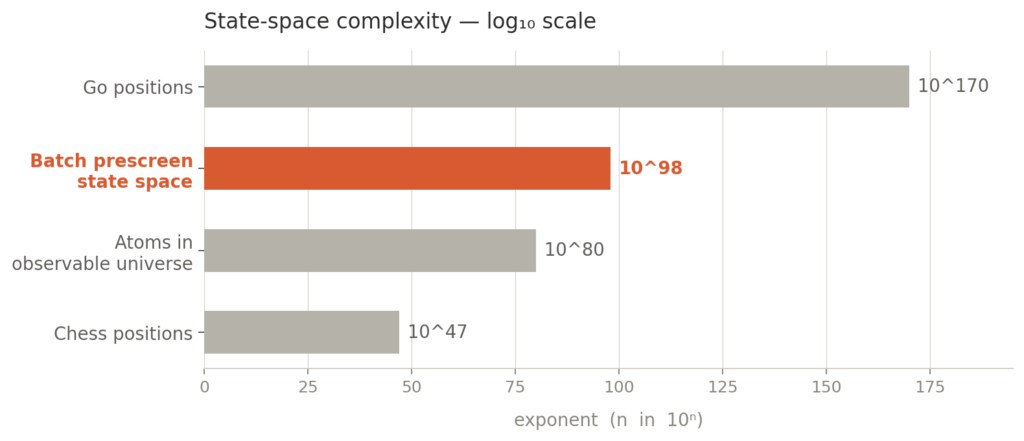
Each of 9 actors (marketing, lending, compliance, bureau, mail house, design, email, vendor ×2) has 7 possible states (idle, working, waiting, reviewing, blocked, defective, unavailable): 7⁹ ≈ 4 × 10⁷. Each of 100 tasks has 8 states (pending, in-progress, awaiting approval, approved, rejected, blocked, failed, escalated): 8¹⁰⁰ = 2³⁰⁰ ≈ 2 × 10⁹⁰. Combined: ~8 × 10⁹⁷.

The batch prescreen process produces a state space of roughly 10⁹⁸ — larger than the number of atoms in the observable universe. That’s not a metaphor for complexity; it’s the combinatorial math.

The practical implication: no human coordination system — no checklist, no project manager, no Slack channel — can reliably navigate a process efficiently with that many possible configurations. Any given campaign run is a single path through an incomprehensibly large space, and most defects and delays occur precisely because the actual state of the process (which vendor has which file, whether the rate is still current, whether the compliance disclosure is in the right version) is unknowable in real time.

Automated prescreen doesn’t reduce the number of tasks. It eliminates most of the state space by making transitions deterministic. When software controls the file transfer, the compliance check, the rate insertion, and the channel queuing, the number of reachable states collapses from ~10⁹⁸ to a small, auditable set. That’s why automation reduces defects and delays structurally, not just operationally — it’s a different class of process.

The Automated Alternative

Automated prescreen — delivered as SaaS — doesn’t just do the same work faster. It restructures the work entirely.

In a properly automated workflow, underwriting criteria, rates, and campaign settings are locked in once. From there, the platform generates the selection file, submits it to the bureau, receives the prescreen file, assembles compliant personalized creative, queues the channel, launches, and posts results — including opened loans, NPV, and indirect sales — with no manual handoffs between steps. The seven tasks that used to require coordination across multiple vendors become a single orchestrated pipeline.

The impact on labor is immediate. Teams that previously spent weeks managing campaign logistics shift to reviewing results and adjusting strategy. The impact on defects is structural — compliance is embedded at each stage rather than verified at the end, which means the rate and disclosure problems that create regulatory exposure in batch workflows are caught and corrected automatically before anything goes to a borrower.

That’s not a coincidence. Speed and quality are usually in tension in manual processes. In automated ones, they compound together.

The 100-Task Problem

The campaign template behind a full prescreen program lists more than 100 individual tasks — file pulls, vendor briefings, proof approvals, transfer confirmations, tracking setups, attribution analyses. In a batch workflow, those tasks are distributed across people, vendors, and calendar weeks. Completing them requires coordination, version control, and organizational memory. Every person who touches the file is a potential defect source. Every week the campaign spends in queue is a week of loan volume waiting to close.

Automated prescreen collapses that task list into a managed pipeline. The institution still owns the decisions — underwriting criteria, channel selection, offer parameters — but the execution is orchestrated by software. The 100 tasks don’t go away. They happen faster, in sequence, with controls, and without distributing the burden across a dozen people and vendors.

A Simpler Argument

The ROI case for automated prescreen is well-established. At $100,000 in annual platform cost, the breakeven is 33 additional funded loans — a conversion lift of just 0.03%. Institutions that achieve the typical realized lift of 0.10% generate $300,000 in incremental revenue, a 3x return before accounting for indirect sales, which on average represent 68% of total campaign loan volume.

But the more fundamental case isn’t financial. It’s structural. Batch prescreen was built for a world where automation wasn’t possible — where lists had to be bought, creatives had to be designed by hand, and mail houses had to receive files by FTP. That world is gone. The question isn’t whether lenders can afford to automate their prescreen programs. It’s whether they can afford not to — while labor costs accumulate, compliance defects wait to surface, and every week of delay hands qualified borrowers to a competitor who already made the offer. And we haven’t even started talking about post campaign analytics and optimization!

So stop singing the batch blues, you just can’t win in that sort of state space; switch to automated prescreen and let’s leave the blues to the musicians.

Read More
June 5, 2026 0 Comments
Surprised Woman Reading Legal Documents in a Restaurant
Behavioral EconomicsMarketing AutomationPrescreen MarketingStrategy

From Batch-and-Blast to Micro-Moment Prescreens

Fifth Third’s CMO reveals why ‘nibbles not vomit’ messaging wins in financial marketing. Here’s how community FIs can apply micro-moment strategy to prescreen campaigns for better loan growth.

Read More
May 29, 2026 0 Comments
10 years logo in silver for celebrations, events and anniversaries.
Digital EngagementMarketing AutomationOnline BankingRetention

Revolutionary Results: How Micronotes Microinterviews Delivered 23x Better Performance Than Banner Ads Over 10 Years

By Devon Kinkead

A decade-long study at a $10 billion financial institution reveals game-changing engagement rates that challenge everything we thought we knew about digital banking marketing.

Executive Summary

In an era where “banner blindness” is consuming precious digital real-estate unproductively, one financial technology stands out as a beacon of hope. Over the past decade (2015-2025), Micronotes Microinterviews have consistently delivered click-through rates averaging 2.3% – a remarkable 23 times better than traditional banner ads used in mobile and online banking applications.

This comprehensive analysis of 10 years of data from a $10 billion financial institution reveals not just superior performance, but a fundamental shift in how financial institutions can effectively engage their customers in the digital age.

The Banner Ad Problem

Previous pre-2015 Doubleclick data shows an average CTR of just 0.05% for all display formats, with current industry research showing banner ad click through rates have fallen to less than 0.1% and continue declining.

The historical context is sobering. Banner clickthrough rates were around 78% in 1994 and have fallen to 0.1% now. Research from MediaMind, which analyzed 21 billion impressions globally, found that online banners had an average of 0.10% click-through rates.

Even more concerning, as many as 60% of clicks on banner ads are accidental. Banner ad blindness is so severe that 92% of users don’t even notice banner ads when surfing the web.

For financial services specifically, the situation remains challenging. The North American average of 0.14% was slightly below the global average for standard banner ads according to Sizmek’s analysis of hundreds of billions of impressions.

The Micronotes Advantage: 10 Years of Consistent Excellence

Overall Performance Metrics

Our analysis of 123 months of data from June 2015 to June 2025 reveals remarkable consistency and performance:

  • Total Unique Views: 8,459,570
  • Total Unique Clicks: 1,578,265
  • Overall Click-Through Rate: 2.3%
  • Average Engagement Rate: 18.7% (Unique clicks/Total Unique Views)

These numbers represent more than just statistics – they represent a fundamental reimagining of customer engagement in financial services.

Year-by-Year Performance Analysis

The data reveals fascinating trends over the decade:

Peak Performance Era (2015-2016)

  • 2015: 4.67% CTR with 401,331 unique visitors
  • 2016: 3.76% CTR with 799,399 unique visitors

Maturation Period (2017-2020)

  • Gradual normalization as user base expanded
  • CTR range: 2.03% – 2.57%
  • Visitor growth: 834,930 to 904,272

Digital Acceleration (2021-2022)

  • 2021 maintained 2.06% CTR
  • Over 1 million visitors annually achieved
  • Sustained performance above 2% CTR

Modern Efficiency (2023-2025)

  • CTR range: 1.16% – 2.12%
  • Visitor base exceeding 1.2 million in 2023
  • Maintained 23x advantage over banner ads

The Science Behind Superior Performance

Why Microinterviews Work Where Banner Ads Fail

1. Contextual Relevance Micronotes Microinterviews integrate seamlessly into the banking journey, appearing at moments when customers are most receptive to relevant financial guidance, for example when they make a large deposit.

2. Personalization at Scale Each Microinterview is tailored to the individual customer’s financial behavior, transaction patterns, and lifecycle stage – creating a sense of personal attention that generic banner ads simply cannot match.

3. Value-First Approach Rather than pushing products, Microinterviews lead with educational content and personalized insights, building trust before introducing relevant solutions.

4. Optimal Timing By leveraging real-time or near real-time banking data, Microinterviews appear when customers are actively engaged with their finances, significantly increasing the likelihood of meaningful interaction.

Industry Context: The Broader Digital Advertising Landscape

The financial services industry faces unique digital marketing challenges in an environment where traditional display advertising continues to deteriorate. For standard banner ads, a CTR of 0.05% is considered average, while static banners typically achieve CTRs around the 0.1% mark.

The decline in banner effectiveness isn’t just about numbers – it’s about fundamental changes in user behavior. We are served more than 1,700 banner ads per month, leading to widespread banner blindness where users actively ignore display advertising.

Regional data reinforces these challenges. Standard banner CTRs were highest for the apparel (0.24%), telecom (0.21%) and retail (0.2%) verticals and lowest for the sports (0.07%), corporate (0.08%) and careers (0.1%) sectors, demonstrating that even in the best-performing industries, banner ads struggle to achieve meaningful engagement.

The Trust Factor: Building Relationships in Financial Services

Financial services marketing faces a fundamental trust challenge. Customers are increasingly skeptical of traditional advertising, with 25% of users employing ad blockers, up 34% from the previous year.

Micronotes addresses this challenge head-on by:

  • Leading with education rather than sales pitches
  • Providing genuine value through personalized financial insights
  • Respecting customer intelligence with sophisticated, relevant content
  • Building relationships rather than chasing transactions

Looking Forward: The Future of Financial Institution Marketing

The implications of this 10-year study extend far beyond a single product’s success story. They point toward a fundamental shift in how financial institutions must approach customer engagement:

From Interruption to Integration

The days of interrupting customers with irrelevant banner ads are numbered. The future belongs to platforms that integrate seamlessly into the customer journey.

From Generic to Personal

Mass marketing messages are increasingly ineffective. Customers expect and respond to personalized, relevant communications that acknowledge their unique financial situation.

From Product-Push to Value-First

Leading with value and education builds trust and engagement in ways that product-focused advertising simply cannot match.

Key Takeaways for Financial Institution Leaders

  1. The Banner Ad Era is Ending: With CTRs below 0.1% and declining, traditional banner advertising in financial services is no longer a viable customer engagement strategy.
  2. Personalization is Non-Negotiable: The 23x performance difference demonstrates the power of relevant, personalized customer communications.
  3. Timing Matters: Engaging customers when they’re actively thinking about their finances dramatically improves response rates.
  4. Trust Through Value: Educational, value-first approaches build the trust necessary for effective financial services marketing.
  5. Integration Over Interruption: The most effective digital engagement happens within, not alongside, the customer’s banking experience.

Conclusion: A New Paradigm for Financial Services Marketing

The 10-year Micronotes study represents more than impressive statistics – it represents proof of concept for an entirely new approach to financial services marketing. In an industry where customer trust is paramount and attention is increasingly scarce, the ability to deliver 2.3% click-through rates consistently over a decade isn’t just impressive; it’s revolutionary.

As financial institutions continue to navigate an increasingly complex digital landscape, the lesson is clear: the future belongs to those who can deliver genuine value through personalized, timely, and relevant customer engagement. The era of spray-and-pray banner advertising is over. The age of intelligent, customer-centric marketing has begun.

For financial institutions still relying on traditional banner advertising with its 0.1% performance rates, the question isn’t whether to evolve – it’s how quickly they can embrace the proven power of personalized, value-driven customer engagement.

The data speaks for itself: 23 times better performance isn’t just an improvement – it’s a complete transformation of what’s possible in financial services marketing. Learn more.

References for Banner Ad Click-Through Rates

SocialSellinator (2024)
“Decoding Display Ad CTR”
“Static Banners: These are the traditional display ads you see on websites. Their CTR is usually around the 0.1% mark”
URL: https://www.socialsellinator.com/social-selling-blog/average-click-through-rate-display-ads

Smart Insights (2025)
“2024 average ad click through rates (CTRs) for paid search, display and social media”
Previous pre-2015 Doubleclick data shows an average CTR of just 0.05% for all display formats
URL: https://www.smartinsights.com/internet-advertising/internet-advertising-analytics/display-advertising-clickthrough-rates/

Marketing Insider Group (2023)
“Banner Ads Have 99 Problems And A Click Ain’t One”
Banner ad click through rates have fallen to less than 0.1%
URL: https://marketinginsidergroup.com/content-marketing/banners-99-problems/

AdPushup
“9 Ways to Improve the Clickthrough Rates of Banner Ads”
There has been a continued decline in banner clickthrough rates, which where around 78% in 1994 and have fallen to 0.1% now
URL: https://www.adpushup.com/blog/9-ways-to-increase-the-clickthrough-rates-of-your-banner-ads/

MediaPost/Marketing Charts (2016)
“Research Brief: North America Banner Click Through Rate Up To 0.14%”
Based on Sizmek study analyzing hundreds of billions of impressions: “The North American average of 0.14% was slightly below the global average”
URL: https://www.mediapost.com/publications/article/290285/north-america-banner-click-through-rate-up-to-014.html

Quora – MediaMind Research Citation
“What are average click-through rates for mobile banner ads?”
MediaMind studied 21 billion telecom impressions that were delivered globally from Q2 2010 to Q1 2011: “Mobile Advertising CTRs averaging 0.64% while online banners had an average of 0.10%”
URL: https://www.quora.com/What-are-average-click-through-rates-for-mobile-banner-ads

Neurons
“How to Increase Display Ad CTR + Examples [Based on Neuroscience]”
“For standard banner ads, a CTR of 0.05% is considered average” and “A 2% click-through rate (CTR) for display ads can be considered good, as it is higher than the average CTR of 0.1%”
URL: https://www.neuronsinc.com/insights/increase-display-ad-ctr-examples-neuroscience

Read More
August 3, 2025 1 Comment
US paper currency with close-up details of one hundred dollar bills. Top view layout with negative space for financial concepts. Banknotes positioned at the top, leaving room for text.
Marketing AutomationPrescreen Marketing

Beyond “Yes” to “Use”: TransUnion vs. Micronotes on Profitable Lending Growth

By Devon Kinkead

Rising acquisition costs and dormant credit lines are pushing lenders to rethink prescreen marketing. TransUnion’s newest brief urges institutions to pursue credit users — customers who will actively revolve and re-engage — instead of mere credit-worthy takers. Micronotes agrees that usage is king, yet argues that always-on Automated Prescreen, powered by Experian, combined with 360-degree post-campaign analytics is what turns every outreach into a continually smarter, dollar-specific firm offer. Both aim for profitable engagement, but their paths — and their feedback loops — differ in crucial ways.

The Problem: Acquisition Cost Inflation

Pain PointTransUnionMicronotes + Experian
Acquisition cost trend+45 % since 2020; > 50 % of new card lines sit inactiveEven a 10 bp lift in conversion rate can flip a campaign from cost center to profit engine when each offer is financially personalized
Targeting gapOnly 9 – 31 % of traditional prescreen names resemble an issuer’s “power users”Real-time bureau math picks prospects who prove value (e.g., refinance savings) inside the offer itself

Why Utilization (Not Just Origination) Matters

  • TransUnion reminds us that inactive lines destroy ROI; usage drives lifetime value.
  • Micronotes pinpoints where usage density is highest — e.g., younger HELOC-for-debt-consolidation borrowers whose typical profile is 761 FICO, $140k income, 91 % card-utilization. Swapping low-utilization “takers” for these high-utilization segments can raise average portfolio utilization — and interest income — without opening more lines.

Segmentation Philosophy

SelectionTransUnionMicronotes + Experian
Core filterGeo-demo & behavioral look-alikes to existing “power users”Real-time credit-bureau math that calculates exact dollar benefit of refinancing/consolidation
High-utilization flagHistorical revolve behavior across issuersEquity ≥ 20 % and card-utilization ≥ 80 % (younger HELOC consolidators)
Success metricMore active accountsAcceptance and built-in usage via visible savings

Offer Construction & Delivery

  • TransUnion: Keep existing mail-house prescreen, but “propensity-swap” marginal prospects for slightly lower-score look-alikes with stronger usage likelihood, boosting originations by 26 %.
  • Micronotes: Dynamic copy such as “Refinance your $37,900 at 8.7 % and save $265/mo” shows concrete cash-flow, then re-presents that savings across email, online banking and SMS until the borrower acts.

Post-Campaign Analytics: Micronotes’ 360-Degree Feedback Loop

Micronotes doesn’t stop at the funded loan. After each drop, the platform ingests multi-dimensional outcome data — loan amount, FICO, income, DTI, rate won/lost, CPA, etc. — and applies three programmatic levers:

  1. Progressive Optimization Model – Treats every campaign as a controlled experiment; results feed the next predictive model to tighten targeting precision.
  2. Competitive Gap Analysis – Surfaces the exact rate spread between wins and losses by segment, guiding pricing and positioning.
  3. Segment-Level CPA Accounting – Calculates cost-per-acquisition by micro-segment, shifting budget to the most efficient pockets automatically.

The outcome: prescreen marketing evolves from quarterly “batch-and-blast” into a continuously optimized system that improves conversion and win-rate every cycle.

Operational Snapshot

ApproachTransUnionMicronotes + Experian
Speed-to-marketOverlay new models on existing flowsCampaigns launch quickly; bureau refresh weekly
ComplianceFits inside current FCRA rulesDisclosure, opt-out & audit trail embedded
Measurement loopEnd-of-campaign origination/balance metricsReal-time dashboards + 360-degree analytics close the loop and auto-refine next drop

Where They Converge — and Diverge

LeverTransUnion FocusMicronotes FocusWhy It Matters
Primary KPIActive accounts & balance growthNet interest income minus CPA and win-rateProfit and improving competitiveness vs. volume
Average UtilizationGradual lift via propensity swapsImmediate spike via high utilization HELOC consolidatorsFaster revenue realization
Tech DependenceModerateHigh (full-stack SaaS + AI analytics)Culture & budget fit

A Unified Playbook

  1. Score for Engagement – Use propensity models to rank users over takers.
  2. Layer Financial Personalization – Add Micronotes’ dollar-savings math to every firm offer.
  3. Prioritize High-Utilization Segments – Younger, equity-rich debt-consolidators deliver outsized utilization immediately.
  4. Automate & Iterate – Feed Micronotes’ 360-degree analytics back into both the propensity model and the offer math so each drop gets sharper.
  5. Measure Holistically – Track funded balance, win-rates, post-booking utilization and CPA by micro-segment — the real driver of lending ROI.

Final Word

TransUnion teaches why focusing on credit users is essential; Micronotes shows how to locate the richest pockets of those users, convert them with personalized math, and then use 360-degree post-campaign analytics to make the next campaign even better. Blend the two approaches and you move the conversation from “Will you take the credit?” to “Here’s how to optimize the credit you already use.” That’s a win for borrowers and the bottom line.

Read More
July 25, 2025 0 Comments
Real Estate Money House
HELOCHome Equity Loan ConsolidationMarketing Automation

From Offer Management to Market Domination: How Automated Prescreen Technology Transforms Financial Institution Growth

By Devon Kinkead

Financial institutions can materially increase conversion rates by modernizing offer management through automated prescreen technology, transforming manual, months-long processes into fast, data-driven customer acquisition engines.

The financial services landscape is experiencing a critical shift. Banks allocate about 45% of their marketing budgets to offers and campaigns, yet average conversion rates remain well below 5%, with 95% of offers destined for the virtual or real trash, while top-performing institutions are seeing dramatically different results. The difference? They’ve transformed offer management from a reactive, manual process into a strategic, technology-driven capability that leverages automated prescreen marketing.

The Hidden Bottleneck: Why Traditional Offer Management Fails

Many institutions have structured their offer management processes around outdated systems that depend on manual steps, from exporting customer lists and hand-coding rules to copying content across channels and awaiting compliance reviews. Each handoff adds friction and delay.

This mirrors the broader challenges facing financial institutions in 2025. Consider the convergence of market conditions creating unprecedented opportunities: 61% of homeowners locked into mortgage rates of 6% or lower and equally reluctant to sell their homes in the next decade, traditional mortgage refinancing has become less attractive. Meanwhile, median home equity has climbed steadily from 35% in 2020 to over 50% in 2024, creating a massive pool of accessible capital.

Yet most financial institutions can’t capitalize on these opportunities because their offer management systems move too slowly. Internal teams often operate under service-level agreements that allow turnaround times of up to two weeks per team. By the time an offer reaches market, the opportunity has often passed.

The Prescreen Advantage: Speed Meets Precision

Automated prescreen technology solves this fundamental challenge by creating a continuous, real-time loop of customer identification, qualification, and engagement. Rather than building offers reactively, institutions can proactively identify prospects and deliver personalized offers instantly.

The impact is measurable and dramatic. Online lenders like Figure, Rocket Mortgage, and Spring EQ are capitalizing on this inefficiency by offering: Approval in minutes vs. 21-day industry average, Closing in one week vs. 36-day industry average, Fixed rates and predictable payments vs. variable rates.

Traditional banks and credit unions can compete—and win—by applying these same principles across their entire product portfolio through intelligent prescreen automation.

Three Pillars of Modern Offer Management

1. Data-Driven Customer Segmentation

Best practices begin with defining a clear vision for each offer. From there, teams should map relevant data, assess the systems involved, and identify redundancies.

Prescreen technology takes this further by continuously analyzing customer behavior, credit profiles, and life events to identify optimal moments for engagement. Three key segmentation strategies emerge: Existing mortgage customers with growing revolving credit balances, Younger, digital-first demographics seeking debt consolidation, Homeowners in high-appreciation markets with substantial equity.

This segmentation becomes the foundation for automated prescreen campaigns that deliver the right offer to the right customer at precisely the right moment.

2. Real-Time Decisioning and Compliance

The most sophisticated prescreen systems integrate compliance checks directly into the automation workflow. Rather than sequential reviews that add weeks to the process, automated systems can validate regulatory requirements, perform credit checks, and ensure fair lending compliance instantaneously.

This addresses a critical pain point: Such long development cycles also tend to drive teams to seek workarounds that add costs even as they seek to circumvent problems. Automated prescreen technology eliminates the need for workarounds by building compliance into the core process.

3. Omnichannel Delivery and Optimization

Modern prescreen systems don’t just identify prospects—they determine the optimal channel, timing, and message for each individual. Whether through digital banking platforms, email, direct mail, or mobile push notifications, the system delivers consistent, personalized experiences across all touchpoints.

This creates the kind of seamless customer experience that drives loyalty and reduces acquisition costs. Speed is critical. With customer needs and credit conditions shifting quickly, banks and credit unions that spend months building offers risk missing opportunities and losing ground to faster-moving competitors.

The Technology Infrastructure That Powers Success

Implementing effective prescreen marketing requires more than just new software—it demands a fundamental shift in how institutions think about customer data and engagement. The most successful implementations include:

AI-Powered Risk Assessment: Machine learning models that continuously refine customer scoring and product matching, improving both conversion rates and portfolio quality.

Dynamic Content Optimization: Systems that automatically test and optimize messaging, imagery, and offers based on real-time performance data.

Integrated Compliance Management: Built-in regulatory frameworks that ensure every automated interaction meets fair lending, privacy, and disclosure requirements.

Performance Analytics: Real-time dashboards that track conversion rates, customer lifetime value, and campaign ROI across all channels and segments.

Case Study: HELOC Marketing in the Rate-Lock Era

The current market conditions provide a perfect example of how prescreen technology can drive growth. The 29.3% of homeowners who have only a first mortgage and over 20% equity represent 28.7 million potential HELOC customers.

Traditional offer management would require months to identify these prospects, develop appropriate messaging, navigate compliance reviews, and launch campaigns. By then, market conditions might have shifted dramatically.

Prescreen automation solves this by:

  1. Continuously monitoring customer mortgage balances, home values, and credit utilization patterns
  2. Instantly identifying when customers cross equity thresholds that make them HELOC candidates
  3. Automatically generating compliant, personalized offers based on current rates and customer profiles
  4. Delivering offers through optimal channels within hours, not weeks

The result? Lenders can capture market share during optimal conditions rather than playing catch-up after opportunities have passed.

Overcoming the “PR Problem” Through Personalization

Experian identifies three critical challenges facing HELOC adoption: Misconceptions about equity-based products, Lack of awareness, Behavioral preferences (credit cards over HELOCs).

Prescreen technology addresses these challenges through intelligent education and timing. Rather than generic marketing campaigns, automated systems can deliver educational content precisely when customers show behaviors indicating need—such as increasing credit card balances or researching home improvement projects.

This proactive approach transforms the customer relationship from reactive (responding to inquiries) to consultative (anticipating needs and providing solutions).

Measuring Success: The Metrics That Matter

The most successful prescreen implementations track metrics across the entire customer journey:

Speed Metrics: Time from opportunity identification to offer delivery, application to approval, and approval to funding.

Conversion Metrics: Response rates, application rates, approval rates, funding rates, and win-rates by segment and channel.

Quality Metrics: Portfolio performance, customer satisfaction scores, and lifetime value by acquisition channel.

Efficiency Metrics: Cost per acquisition, marketing spend per dollar of funded loans, operational costs per transaction.

Banks and credit unions that apply modern best practices in creating, deploying and optimizing offers are seeing dramatic gains across performance metrics — from customer retention and conversions to upsell rates and time-to-market.

The Competitive Imperative: Act Now or Fall Behind

The convergence of market opportunity and technological capability creates a narrow window for competitive advantage. Banks that successfully integrate the technology optimization strategies outlined in the BAI report with targeted HELOC marketing will capture market share in one of 2025’s most promising lending segments.

This principle extends far beyond HELOCs. Whether the opportunity is deposit growth, credit card acquisition, or wealth management expansion, institutions that can move from opportunity identification to customer engagement in hours rather than weeks will consistently outperform their competitors.

The question isn’t whether to modernize offer management—it’s whether to lead the transformation or follow it.

Getting Started: A Roadmap for Implementation

For institutions ready to transform their offer management capabilities, the path forward involves:

Phase 1: Assessment and Planning

  • Audit current offer management processes and identify bottlenecks
  • Evaluate data quality and integration capabilities
  • Define success metrics and business objectives

Phase 2: Technology Selection and Integration

  • Choose prescreen platforms that integrate with existing core systems
  • Implement data governance frameworks for automated decision-making
  • Establish compliance workflows for automatic compliant offer generation

Phase 3: Testing and Optimization

  • Launch pilot campaigns with limited product sets and customer segments
  • Megastudy test messaging, channels, and timing strategies
  • Refine strategies based on performance data, particularly win-rate performance.

Phase 4: Scale and Expand

  • Roll out successful strategies across additional products and markets
  • Integrate advanced AI and machine learning capabilities
  • Build comprehensive omnichannel customer experiences

Conclusion: The Future of Customer Acquisition

The intersection of technology optimization and HELOC marketing opportunity represents more than just product promotion—it’s about fundamental business model evolution. This insight applies across all financial products and services.

The institutions that will thrive in 2025 and beyond are those that view technology not as a cost center, but as a competitive weapon. By transforming offer management from a reactive, manual process into a proactive, automated capability, banks and credit unions can capture market opportunities faster, engage customers more effectively, and drive sustainable growth.

The technology exists. The market conditions are favorable. The competitive advantage awaits those bold enough to seize it.

The time to transform offer management from operational necessity to strategic superpower is now. Learn more

Read More
June 14, 2025 0 Comments
Dark Wall Illuminated from the Left Corner Spotlight Lamp
AIMarketing Automation

Illuminating the Path Forward: How AI-Driven Financial Institutions Are Outperforming Traditional Data Approaches

By Devon Kinkead

While recent studies highlight challenges in banking data practices, suggesting institutions are “flying in the dark,” a growing segment of forward-thinking financial institutions is proving that strategic AI implementation and advanced analytics can transform data from a burden into a competitive advantage. Rather than being grounded by imperfect data infrastructure, these institutions are soaring ahead by leveraging intelligent systems that work with real-world data conditions.

The Reality Check: Perfect Data Is a Myth

The notion that banks need “clean, structured and available” data before they can scale their business fundamentally misunderstands how modern AI and machine learning systems operate. Real-world financial institutions don’t have the luxury of waiting for perfect data infrastructure—they need solutions that can extract value from the data they have today while continuously improving over time.

Consider a recent case study from a personal loan campaign targeting debt consolidation prospects in Greater Los Angeles. Despite distributing thousands of loan offers across 42 cities and capturing only 13% of the available market initially, AI-powered post-campaign analysis quickly diagnosed specific gaps and delivered four actionable, compliance-cleared recommendations that could improve loan acquisition rates by 5-8% and increase funded volume by up to 40%.

This demonstrates that the question isn’t whether your data is perfect—it’s whether you have the right analytical tools to extract actionable insights from imperfect data.

From Data Quality to Data Intelligence

Traditional approaches to banking data focus heavily on governance, quality, and compliance—essentially building the perfect data foundation before attempting to derive value. While these elements remain important, this approach often creates analysis paralysis and delays competitive action.

Progressive financial institutions are instead embracing a different philosophy: deploy intelligent systems that can work with existing data while continuously learning and improving. Modern AI systems excel at pattern recognition within noisy, incomplete datasets—exactly the conditions most banks face today.

For instance, advanced analytics platforms can process 230 million credit records weekly, identifying untapped opportunities within a financial institution’s operating footprint and enabling targeted, personalized marketing campaigns that resonate with individual customers’ current financial situations. This level of operational capability doesn’t require perfect data—it requires intelligent systems that can extract value from available data sources.

The Engagement Revolution: From Data Hoarding to Customer Connection

Perhaps the most significant blindspot in traditional banking data approaches is the assumption that data value comes primarily from internal analysis. Leading institutions are discovering that the most valuable data insights come from direct customer engagement—not just analyzing what customers have done, but understanding what they need next.

Modern machine learning driven engagement platforms can validate individual customer needs by conducting meaningful conversations with up to 20% of online banking users monthly. This approach generates fresh, real-time data about customer intentions while simultaneously delivering personalized service. Instead of relying solely on historical transaction patterns, these systems capture forward-looking customer preferences and life event triggers.

Consider the power of this approach: when a customer makes an atypically large deposit, traditional data analysis might flag this as an anomaly. An intelligent engagement system recognizes this as a life event trigger and immediately initiates a personalized conversation to understand the customer’s needs and offer relevant solutions. Research shows that 54% of these customers typically withdraw their deposits within 90 days if not contacted—but proactive engagement can retain these significant deposits while deepening customer relationships.

Precision Over Perfection: The Competitive Advantage

While some institutions struggle with the gap between current data infrastructure and AI requirements, successful organizations are leveraging existing capabilities to gain immediate competitive advantages. The key insight is that AI systems don’t need perfect data—they need sufficient data combined with intelligent algorithms that can identify patterns and opportunities.

Advanced segmentation algorithms can categorize customers based on credit profiles and borrowing costs, delivering insights that traditional demographic analysis simply cannot match. This granular understanding enables banks to deploy risk-based tiered pricing strategies, align loan offers with borrower demand, and microtarget high-yield geographic zones—all based on existing data sources enhanced by machine learning.

The results speak for themselves: institutions implementing these approaches report 5-15% increases in campaign revenue, 26 times higher click-through rates compared to banner advertising, and 15-20% operational cost reductions within two years.

Real-Time Intelligence Beats Perfect Data

The banking industry’s traditional approach to data infrastructure resembles building a perfect library—organizing every piece of information before attempting to learn from it. But in today’s fast-moving financial landscape, institutions need real-time intelligence that can operate more like a skilled detective, finding meaningful patterns within available evidence and acting on them immediately.

Modern AI-driven platforms demonstrate this principle by continuously learning from customer interactions and market conditions. Every conversation, every campaign response, and every customer decision feeds back into predictive models that become more accurate over time. This creates a virtuous cycle where data quality improves through use rather than through upfront investment.

Regulatory Compliance as an Enabler, Not a Barrier

One of the most significant advantages of modern AI-driven banking solutions is their built-in compliance framework. Rather than treating regulatory requirements as obstacles to data utilization, intelligent systems can ensure that every insight, recommendation, and customer interaction meets strict regulatory standards.

For example, AI-powered prescreen campaign optimization automatically ensures compliance with FCRA permissible purpose requirements, Equal Credit Opportunity Act provisions, and truth-in-lending standards. This means banks can move faster and with greater confidence, knowing that their data-driven strategies are both effective and compliant.

The Path Forward: Embracing Intelligent Action

The financial institutions that will thrive in the coming years are not those waiting for perfect data infrastructure, but those implementing intelligent systems that can extract maximum value from current resources while continuously improving their capabilities.

This approach requires a fundamental shift in mindset—from data perfectionism to intelligent action. Instead of asking “Is our data clean enough?” the question becomes “What insights can we extract from available data, and how quickly can we act on them?”

The evidence is clear: institutions that embrace AI-driven analytics and engagement platforms are not flying in the dark—they’re illuminating new paths to customer understanding, operational efficiency, and competitive advantage. They’re proving that in the modern banking landscape, intelligence matters more than perfection, and action delivers better results than preparation.

While data governance and infrastructure improvements remain important long-term investments, banks cannot afford to wait for perfect conditions before leveraging the transformative power of AI and advanced analytics. The institutions moving ahead today are those that recognize that the best time to start extracting value from data is right now, with the tools and data they have available.

The future belongs to financial institutions that combine human insight with artificial intelligence, creating systems that can think, learn, and adapt in real-time. These organizations aren’t flying in the dark—they’re using advanced navigation systems that help them see further and move faster than ever before. Learn more

Read More
June 13, 2025 0 Comments
a woman making and showing number three hand sign
Marketing AutomationPersonalizationPrescreen Marketing

Crossing the 3 BPS Threshold: The Simplest ROI Decision Your Credit Union Will Ever Make

By Joe Heller

Credit unions are constantly searching for efficient ways to grow their loan portfolios while managing costs. One strategy stands out for its effectiveness: prescreening — the practice of making pre-approved credit offers to qualified members and prospects. However, the traditional prescreening process is labor-intensive and often yields conversion rates that leave significant room for improvement.

That’s where Micronotes Automated Prescreen changes the game. Our analysis reveals a compelling truth: any credit union that prescreens today or plans to prescreen should use Micronotes. Here’s why.

The Economics Are Undeniable

Our ROI analysis demonstrates that even a minimal improvement in conversion rates delivers substantial returns. Consider these numbers from our recent analysis:

  • Current average prescreen conversion rate: 0.25%
  • Automated prescreen annual cost: $100,000 (excluding data and direct mail pass-throughs)
  • Average net income per loan: $3,000
  • Typical annual prescreen volume: 100,000 offers

With these figures, the math becomes straightforward:

The Breakeven Point Is Remarkably Low

A credit union needs just 33.3 additional funded loans annually to cover the cost of Micronotes. This translates to a required conversion rate increase of just 0.03% — moving from 0.25% to 0.28%.

Let that sink in. If your credit union is planning to send 100,000 prescreen offers this year, you need only 33 more of those offers to convert to loans to completely cover the cost of automating and optimizing your entire prescreen operation.

The Realistic Returns Are Substantial

Based on our experience and data, credit unions implementing Micronotes Automated Prescreen typically see conversion rate improvements of 0.10% or higher. At this conservative estimate:

  • New conversion rate: 0.35% (up from 0.25%)
  • Additional annual revenue: $300,000
  • ROI: 300% (a 3x return on investment)

And this calculation doesn’t even account for the reduced labor costs and operational efficiencies gained by automating your prescreen process. It also doesn’t cover programmatic improvements in conversion rates through win-rate analytics.

Beyond the Numbers: Strategic Benefits

The ROI analysis tells a compelling financial story, but the benefits extend beyond dollars and cents:

  1. Team Efficiency: Your marketing and lending teams can focus on higher-value strategic activities rather than managing prescreen campaigns.
  2. Data-Driven Optimization: Our platform continuously analyzes performance data to refine targeting and messaging, steadily improving conversion rates over time.
  3. Simplified Compliance: Our automated system helps ensure consistent compliance with regulatory requirements.
  4. Enhanced Member Experience: More relevant offers delivered at the right time lead to higher member satisfaction.

Is Automated Prescreen Right for Your Credit Union?

If your credit union does any of the following, Micronotes delivers clear value:

  • Currently runs prescreen campaigns (regardless of size or frequency)
  • Plans to implement prescreen marketing in the near future
  • Wants to grow loan volume through targeted hyper-personalized marketing
  • Seeks to improve efficiency of existing marketing operations

If your strategy relies heavily on other channels like indirect lending or general marketing platforms, Micronotes may not be your primary solution. But for any credit union with prescreen as part of its growth strategy, the business case is clear.

The Bottom Line

The data doesn’t lie: a 0.03% increase in conversion rate covers your costs. A realistic 0.10% improvement delivers a 3x return on investment. With Micronotes, you’re not just hoping for better results—you’re investing in a proven system that delivers measurable ROI while freeing your team to focus on what matters most.

For credit unions serious about growing their loan portfolios efficiently, Automated Prescreen isn’t just a nice-to-have—it’s a financial imperative.


Ready to see how Automated Prescreen can transform your credit union’s marketing efficiency and ROI? Contact us today for a personalized analysis based on your specific portfolio and goals.

Read More
April 9, 2025 0 Comments
Stressed and headache asian woman with large bills or invoices no money to pay to expenses and credit card debt. shortage, Financial problems, mortgage, loan, bankruptcy, bankrupt, poor, empty wallet
Home Equity Loan ConsolidationMarketing AutomationPersonalizationPrescreen Marketing

How Automated Prescreen Makes Hyper-Personalized HELOC Debt Consolidation a Reality

By Devon Kinkead

Financial institutions are constantly searching for more effective ways to identify high-value opportunities and connect with qualified borrowers and people need their help. The HELOC debt consolidation opportunity represents one of the most promising avenues for growth given both record credit card debt and home equity, but executing these campaigns efficiently has traditionally required significant resources and expertise.

The Evolution of Prescreen Marketing

The concept of finding mispriced debt is compelling, but the execution has historically been challenging. Financial institutions needed to manually coordinate between credit bureaus, marketing teams, and compliance departments to create effective prescreen campaigns. This cumbersome process often resulted in generic offers that failed to capture consumer attention.

Enter automated prescreen technology – a game-changing approach that transforms how financial institutions target both existing customers and prospects with personalized HELOC consolidation offers.

How Automation Powers Hyper-Personalization

Modern automated prescreen solutions leverage advanced algorithms and real-time data access to create truly personalized HELOC offers. Here’s how the technology makes hyper-personalization possible:

1. Comprehensive Data Integration

Micronotes Automated Prescreen combines multiple data sources:

  • Credit bureau data on 230+ million consumers (updated weekly)
  • Property values and equity positions
  • Current loan terms and interest rates
  • Financial institution’s core data
  • Underwriting criteria and rate sheets

This integration allows for precise identification of consumers with mispriced debt who could benefit from HELOC consolidation.

2. Financial Personalization That Drives Results

Rather than generic “You’re pre-approved” messaging, automated prescreen enables specific offers like:

“John, you can refinance your $40,639 debt from 19.890% to 8.642% and stop overpaying $280 per month in interest.”

This financially personalized approach leverages behavioral economics principles to demonstrate concrete value, resulting in higher conversion rates and win rates for loans.

3. Geotargeting Built Into the Process

The system automatically applies geographic filters to ensure targeting remains focused on prospects within the financial institution’s footprint. This ensures branch proximity for people who prefer in-person interactions while maximizing operational efficiency and brand recognition.

4. Multi-Channel Delivery for Maximum Impact

Once identified and personalized, offers can be delivered through multiple channels with friction-reducing calls to action:

  • Custom branded email
  • Direct mail with personalized tables and charts
  • Digital banking re-presentment
  • QR codes for easy response

5. Compliance Built Into the Workflow

Perhaps most importantly, Automated Prescreen handles the complex regulatory requirements for firm offers of credit, ensuring all communications include required disclosures and follow FCRA and UDAAP rules.

The Business Case for Automated Prescreen

For financial institutions considering HELOC debt consolidation campaigns, automated prescreen technology delivers compelling benefits:

  1. Reduced Manual Effort: Automation handles the complex data analysis and offer generation that would otherwise require significant staff resources.
  2. Negative Acquisition Costs: The net interest income from successful HELOC consolidations typically exceeds campaign costs, creating a self-funding growth engine.
  3. Expanded Market Share: Target qualified prospects who don’t currently have a relationship with your institution.
  4. Increased Wallet Share: Identify existing accountholders who hold high-interest debt with competitors, bringing those relationships to your institution.
  5. Continuous Optimization: Performance tracking shows which offers resonate best, allowing for ongoing refinement rather than one-off campaigns.

Moving Forward: From Concept to Campaign

Implementing a successful HELOC debt consolidation campaign using Automated Prescreen doesn’t require massive internal resources or years of data science expertise. Micronotes’ cloud-based solution provide the technology infrastructure while financial institutions maintain control over targeting criteria, offer parameters, and brand presentation.

The campaigns can support multiple loan types simultaneously, including:

  • HELOC/HELOAN consolidation
  • Traditional HELOC/HELOAN
  • Auto loan refinance
  • Personal loan consolidation
  • Mortgage new home purchase

Take the Next Step

If you’re interested in capturing the huge HELOC debt consolidation opportunity within your footprint, it’s time to explore how Automated Prescreen can transform your marketing approach and deliver the numbers, this year.

Order your own growth analysis today or book a demo to learn how you can start acquiring and retaining more profitable relationships through Micronotes. In a market where every advantage matters, Automated Prescreen may be the differentiator your institution needs.

Read More
April 3, 2025 0 Comments
  • 1
  • 2

Recent Posts

  • Why Prescreen Timing Beats Prescreen Volume for Loan Growth
  • The 10-Year Loan Growth Strategy Hiding in Your Financial Education Program
  • Why Your Onboarding Sequence Should Start With a Firm Offer
  • Stop Optimizing for Your Existing Portfolio
  • Why Delinquency Headlines Are a Surgical Precision Targeting Problem, Not a Credit Crisis
Categories
  • Affluent 1
  • AI 35
  • Auto Lending 6
  • Behavioral Economics 9
  • Big Data 20
  • Blog 16
  • Brand 1
  • Community Banking 25
  • Community Financial Institutions 18
  • Compliance 2
  • Consumer Loan Business 9
  • Credit Cards 2
  • Credit Trends 2
  • CRM 2
  • Customer Retention 14
  • Deposits 36
  • Digital Engagement 9
  • First-Time Homebuyer 2
  • Gen Y 2
  • GenZ 16
  • HELOC 10
  • Home Equity Loan Consolidation 12
  • Life Events 11
  • Loan Growth 18
  • Marketing Automation 20
  • Net Promoter Score 2
  • New Customer Acquisition 23
  • NEWS 1
  • NPS 1
  • Online Banking 6
  • Personalization 35
  • Prescreen Marketing 84
  • Research 3
  • Retention 9
  • ROI 2
  • Strategy 32
  • Sustainability 1
  • Uncategorized 3

Micronotes.ai Logo

What We Do
How We Do It
Products
Resources
Who We Are
Blog
Request a Demo
Free Growth Analysis
Log In

Privacy Policy | Copyright © 2024 Micronotes Inc. All Rights Reserved.