
Singing the Batch (precreen) Blues


The basic structure of the blues is 12 bars. It’s 12 measures that relies on just three chords built off the 1st, 4th, and 5th scale degrees of a key. The batch prescreen blues is a progression of 100+ major tasks coordinated across multiple vendors and given all the delays and defects, can really bring a marketing and lending team down.
However, prescreen marketing remains the most effective tool a lender has for growing a quality loan portfolio. A pre-approved, personalized offer — “John, refinance your $40,639 in debt from 19.89% to 8.64% and stop overpaying $280 a month” — outperforms every other form of credit marketing because it is specific, credible, and FCRA-compliant. The borrower doesn’t have to wonder if they qualify. The lender doesn’t have to guess who to reach. The math is right there on the page.
So why do so many lenders leave so much of this opportunity on the table? The answer is usually the same: the batch prescreen blues.
What “Batch” Actually Costs
A typical batch prescreen campaign involves more than 100 discrete tasks distributed across the lender’s marketing, lending, and compliance teams, a credit bureau, a mail house, a design agency, email providers, and often an additional data vendor or two. Each of those tasks is a handoff. Each handoff is a potential failure point. And together they generate three costs that compound quietly over time: labor, defects, and delays.
Labor is the most visible. Someone has to buy the list, brief the designer, write the compliance disclosures, transfer the file, check the proofs, coordinate the mail drop, and pull the response data when it trickles in weeks later. Then someone has to do it again for the next campaign. Marketing teams at community banks and credit unions are rarely large to begin with — and over the last decade they’ve gotten smaller. The operational overhead of batch prescreen is a significant and often invisible tax on those teams. Every hour spent on campaign logistics is an hour not spent on strategy, creative, or analysis.
Defects are harder to see but more expensive. In a multi-vendor, multi-step workflow, errors compound. A file transferred with the wrong segment filter. A compliance disclosure that didn’t make it into the final proof. A rate that was accurate when the creative was drafted but moved before the mailer dropped. In a manual process, each of these is a human failure waiting to happen — and the consequence isn’t just rework. A defective prescreen offer can trigger a regulatory problem under the FCRA, the ECOA, or UDAAP. The compliance risk in batch prescreen isn’t hypothetical; it’s inherent to any process where compliance is a final checkbox rather than an embedded control.
Delays are perhaps the most strategically damaging cost of all. A prescreen offer is time-sensitive by nature. The bureau data that identifies a qualified borrower reflects a credit profile at a moment in time. Rates change. Competitors are running their own campaigns against the same population. The lender who reaches a borrower first with a compelling firm offer captures the loan. The lender who takes eight weeks to execute a batch campaign — buying the list, designing creative, routing through compliance, queuing at the mail house — often arrives after someone else already has. Lead time isn’t just an operational metric. It’s a competitive disadvantage measured in lost loans.
To get a sense of how complex this process is, here’s the math:
Each of 9 actors (marketing, lending, compliance, bureau, mail house, design, email, vendor ×2) has 7 possible states (idle, working, waiting, reviewing, blocked, defective, unavailable): 7⁹ ≈ 4 × 10⁷. Each of 100 tasks has 8 states (pending, in-progress, awaiting approval, approved, rejected, blocked, failed, escalated): 8¹⁰⁰ = 2³⁰⁰ ≈ 2 × 10⁹⁰. Combined: ~8 × 10⁹⁷.
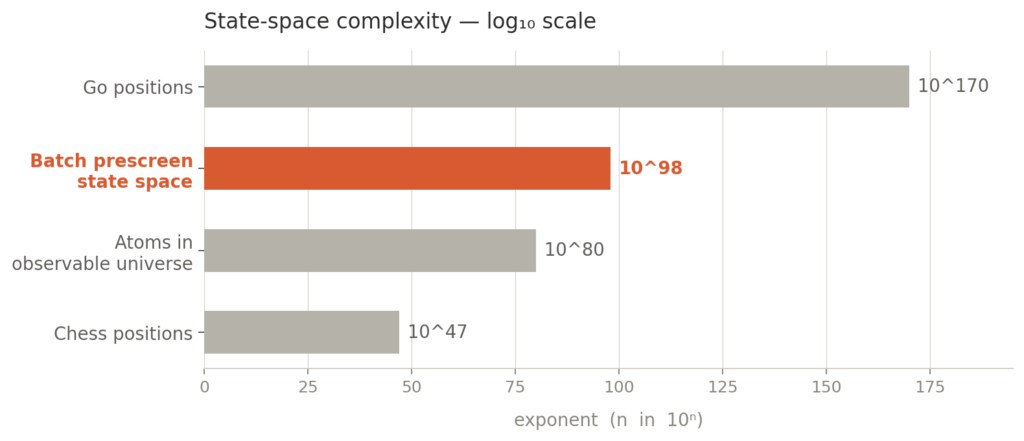
The batch prescreen process produces a state space of roughly 10⁹⁸ — larger than the number of atoms in the observable universe. That’s not a metaphor for complexity; it’s the combinatorial math.
The practical implication: no human coordination system — no checklist, no project manager, no Slack channel — can reliably navigate a process efficiently with that many possible configurations. Any given campaign run is a single path through an incomprehensibly large space, and most defects and delays occur precisely because the actual state of the process (which vendor has which file, whether the rate is still current, whether the compliance disclosure is in the right version) is unknowable in real time.
Automated prescreen doesn’t reduce the number of tasks. It eliminates most of the state space by making transitions deterministic. When software controls the file transfer, the compliance check, the rate insertion, and the channel queuing, the number of reachable states collapses from ~10⁹⁸ to a small, auditable set. That’s why automation reduces defects and delays structurally, not just operationally — it’s a different class of process.
The Automated Alternative
Automated prescreen — delivered as SaaS — doesn’t just do the same work faster. It restructures the work entirely.
In a properly automated workflow, underwriting criteria, rates, and campaign settings are locked in once. From there, the platform generates the selection file, submits it to the bureau, receives the prescreen file, assembles compliant personalized creative, queues the channel, launches, and posts results — including opened loans, NPV, and indirect sales — with no manual handoffs between steps. The seven tasks that used to require coordination across multiple vendors become a single orchestrated pipeline.
The impact on labor is immediate. Teams that previously spent weeks managing campaign logistics shift to reviewing results and adjusting strategy. The impact on defects is structural — compliance is embedded at each stage rather than verified at the end, which means the rate and disclosure problems that create regulatory exposure in batch workflows are caught and corrected automatically before anything goes to a borrower.
That’s not a coincidence. Speed and quality are usually in tension in manual processes. In automated ones, they compound together.
The 100-Task Problem
The campaign template behind a full prescreen program lists more than 100 individual tasks — file pulls, vendor briefings, proof approvals, transfer confirmations, tracking setups, attribution analyses. In a batch workflow, those tasks are distributed across people, vendors, and calendar weeks. Completing them requires coordination, version control, and organizational memory. Every person who touches the file is a potential defect source. Every week the campaign spends in queue is a week of loan volume waiting to close.
Automated prescreen collapses that task list into a managed pipeline. The institution still owns the decisions — underwriting criteria, channel selection, offer parameters — but the execution is orchestrated by software. The 100 tasks don’t go away. They happen faster, in sequence, with controls, and without distributing the burden across a dozen people and vendors.
A Simpler Argument
The ROI case for automated prescreen is well-established. At $100,000 in annual platform cost, the breakeven is 33 additional funded loans — a conversion lift of just 0.03%. Institutions that achieve the typical realized lift of 0.10% generate $300,000 in incremental revenue, a 3x return before accounting for indirect sales, which on average represent 68% of total campaign loan volume.
But the more fundamental case isn’t financial. It’s structural. Batch prescreen was built for a world where automation wasn’t possible — where lists had to be bought, creatives had to be designed by hand, and mail houses had to receive files by FTP. That world is gone. The question isn’t whether lenders can afford to automate their prescreen programs. It’s whether they can afford not to — while labor costs accumulate, compliance defects wait to surface, and every week of delay hands qualified borrowers to a competitor who already made the offer. And we haven’t even started talking about post campaign analytics and optimization!
So stop singing the batch blues, you just can’t win in that sort of state space; switch to automated prescreen and let’s leave the blues to the musicians.